.webp)



find us
47 rue Charlot, 75003 Paris, France
Kikar Kedumim 14, Tel Aviv-Yafo, 68037, Israel
contact us
t. +33 (0)1 42 76 02 67
e. info@galeriecharlot.com





Laurent Mignonneau & Christa Sommerer
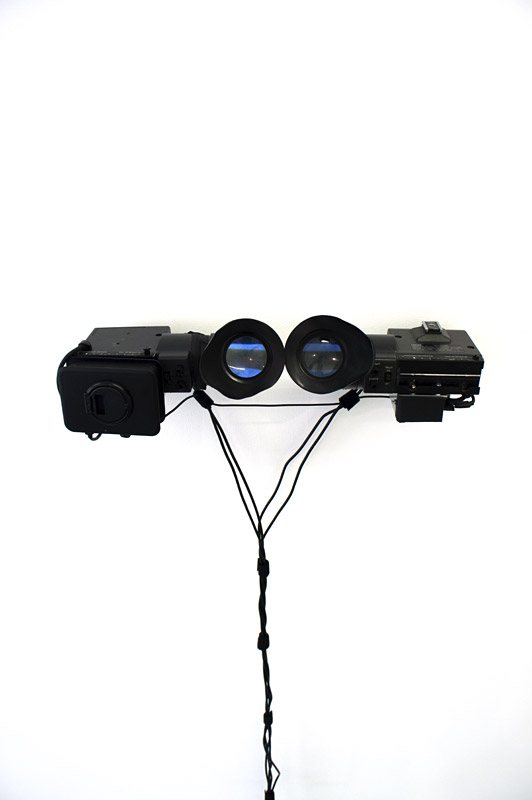
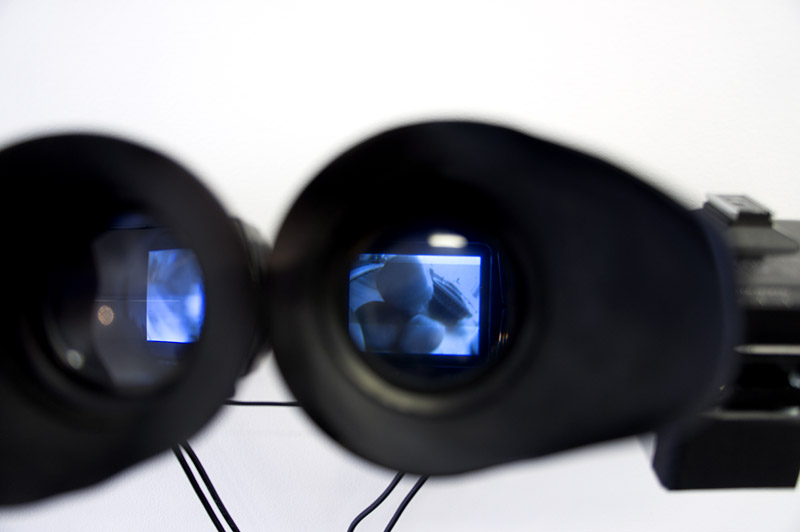
The third solo exhibition by Laurent Mignonneau and Christa Sommerer at Galerie Charlot, On the Fly brings together several interactive installations whose common thread is the fly — the trompe-l'œil creature par excellence.


The fly has haunted the history of painting since Antiquity. As the figure of the musca depicta, it is the emblem of trompe-l'œil, the challenge thrown down by the artist to nature and to the viewer's eye. Christa Sommerer and Laurent Mignonneau seize upon this pictorial topos to bring it into the field of interactive and digital art: in their work, the fly is not painted but generated, simulated, brought to life by algorithms and by the gestures of the public.
Pioneers of interactive art since the 1990s, the two artists have developed a practice in which the boundary between the real and the virtual, between the living and the simulated, becomes the true subject of the work. Their installations invite viewers to enter into a direct relationship with artificial systems that behave like living organisms: they react, adapt and evolve. On the Fly pushes this exploration in an unexpected and playful direction, summoning art history the better to outwit it, and reminding us that illusion — whether painted or digital — lies at the very foundation of all representation.
“It is said that Giotto, while still young and in Cimabue's workshop, once painted on the nose of a figure made by Cimabue a fly so lifelike that the master, returning to work, tried several times to brush it away with his hand; he believed it real until the moment he understood his illusion.” Vasari, Lives of the Most Excellent Painters, Sculptors and Architects
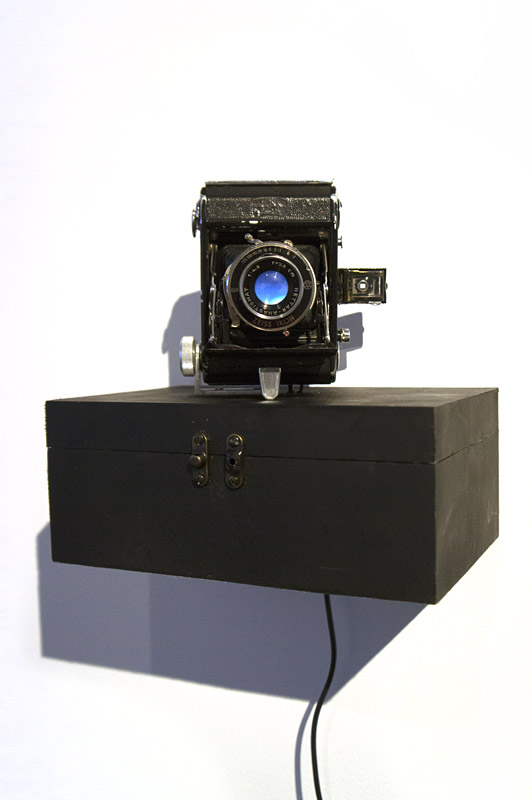
The third solo exhibition by Laurent Mignonneau & Christa Sommerer at Galerie Charlot, “On the fly”, presents various interactive installations whose common element is the fly. Following the tradition of the “Musca depicta” in classical European painting, the artists bring this thousand-faceted insect into contemporary art.
Certain fifteenth- and sixteenth-century portraits from Northern Italy, Flanders and Germany have raised many questions about the incongruous presence of this insect, as in the “Madonna and Child” by Carlo Crivelli and that by Giorgio Schiavone, or in Francesco Benaglio's “Saint Jerome”. While it is often a symbol of evil and death, some critics interpret this detail as a form of provocation. Such is the case of the trompe-l'œil fly painted on the frame, just above the artist's name, in “Portrait of a Carthusian” by the Flemish Primitive painter Petrus Christus. Frozen in that instant, on the border between reality and representation, this fly is proof of the painter's skill in toying with the viewer's senses and giving them the illusion of life.
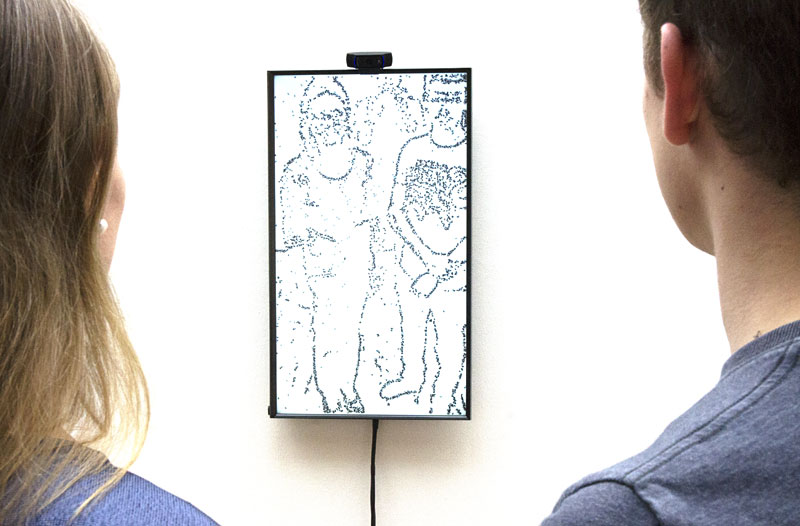
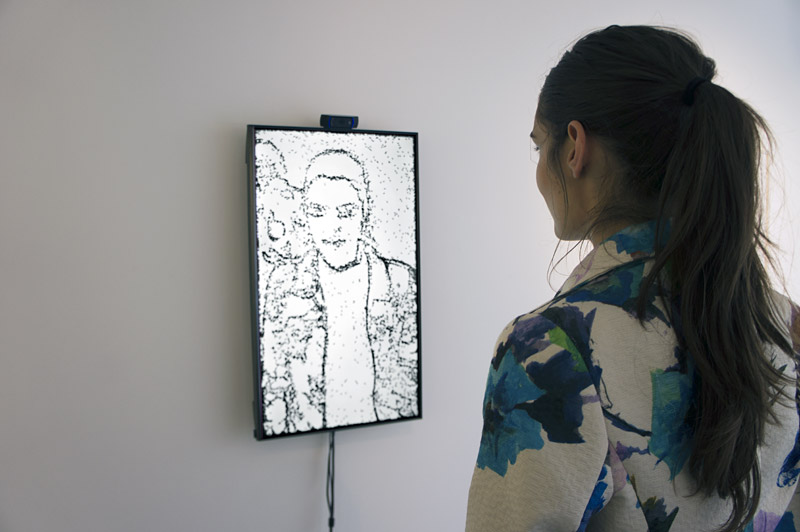
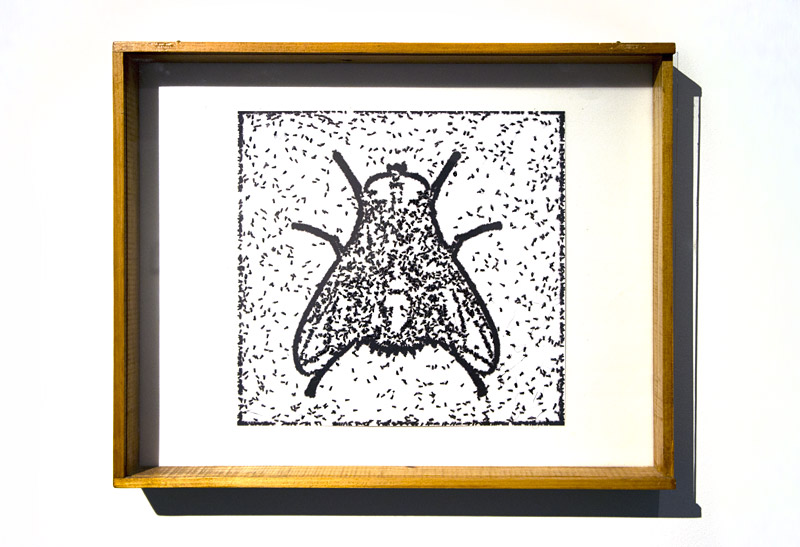
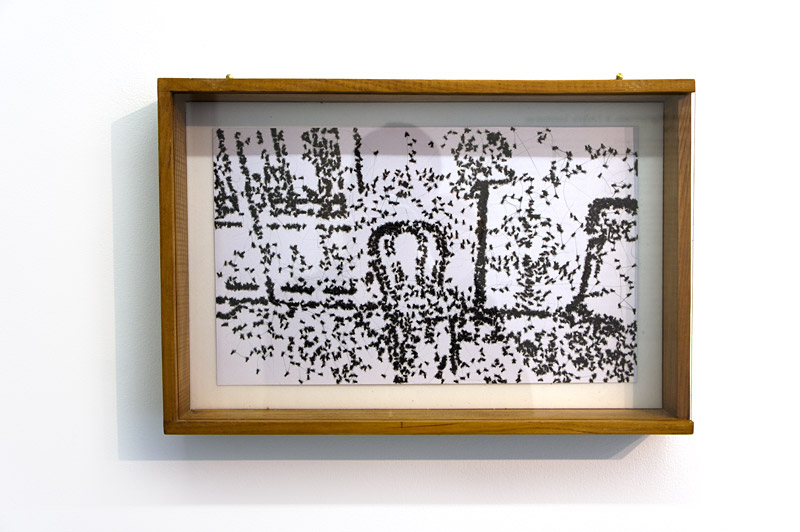
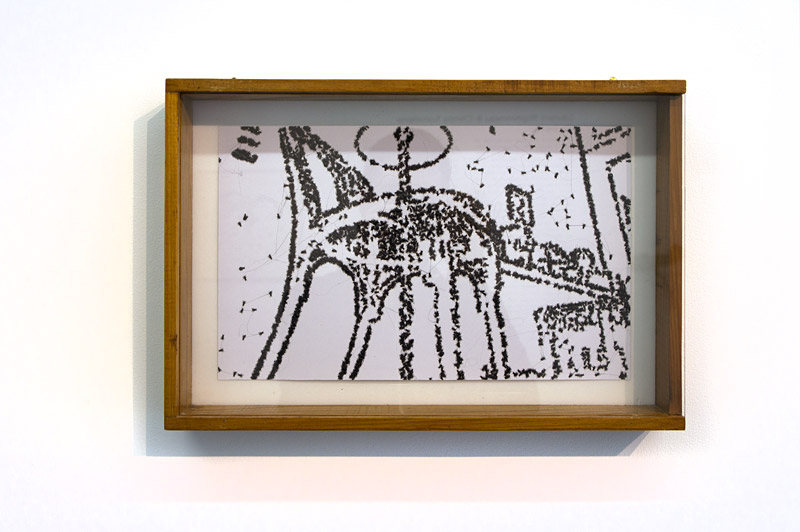
Laurent Mignonneau & Christa Sommerer's “Portrait on the Fly” is also based on a trompe-l'œil: the swarm of flies buzzing on the screen turns out to be the image of a single fly multiplied 10,000 times. The artists confront us with this illusion between reality and representation.
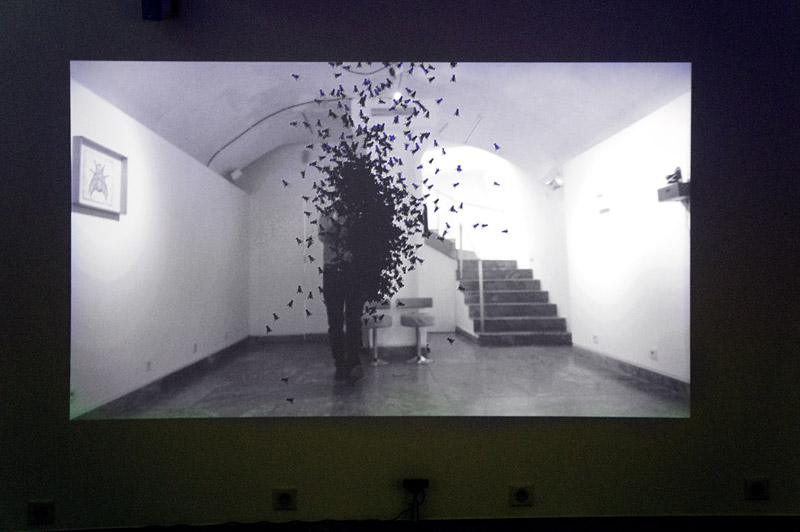
In Petrus Christus's portrait, the fly placed “outside the frame” also signals the two-dimensionality of the work. The perception of space is thereby altered. Likewise, in Laurent Mignonneau & Christa Sommerer's installation, the viewer's presence gives new depth to the virtual image of the swarm of flies; drawn by the presence and visual contrasts of the person before them, the flies quickly form that person's silhouette.
Laurent Mignonneau & Christa Sommerer's works highlight this ambivalence between materialisation and dematerialisation, construction and deconstruction, presence and absence. In constant flux, the portrait is endlessly redefined according to the position of the flies and the movement of the viewers.
This subtle dynamic of appearance and disappearance brings us back to another meaning of the fly in the history of art: as a memento mori, a sign that unequivocally recalls the fleetingness and temporality of life.
Some of Laurent Mignonneau & Christa Sommerer's interactive installations emphasise a lesser-known symbolism of the fly: its resistance. An aspect highlighted by two very distant fields such as Western heraldry and shamanism, the fly is also an emblem of tenacity, determination and persistence: it is the insect that never gives up.
Thus viewers are this time led to experience the opposite: once it has identified the silhouette, and despite attempts to chase it away through movement, the swarm of flies, through its resistance, clothes them in a mantle of happiness and benevolence.
Through this reflection on our relationship to reality, on the status of the body and its image within this flow, and on “selfie” culture, the artists warn us about the contemporary process of the dematerialisation of the world.


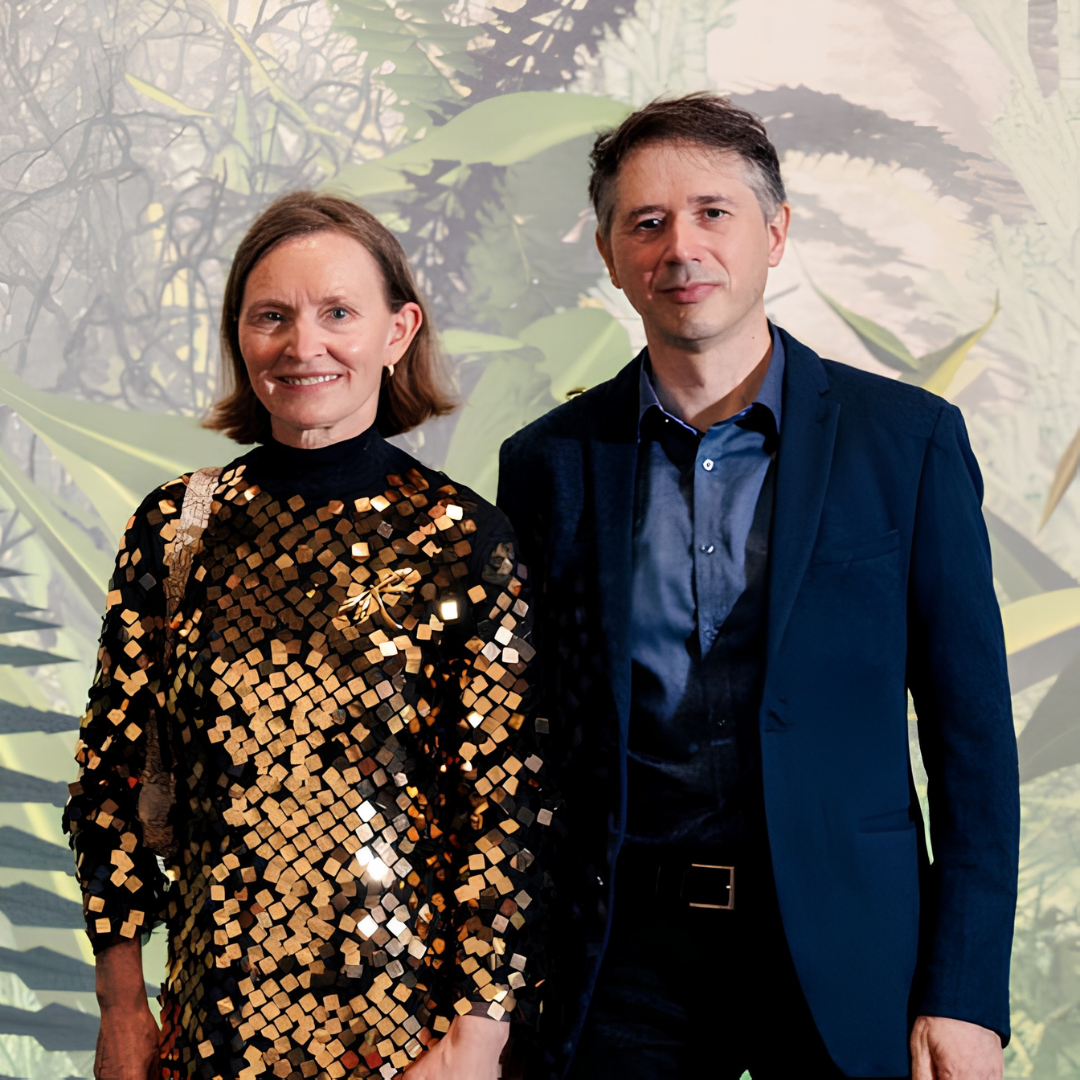
Laurent Mignonneau, French. Christa Sommerer, Austrian. They live and work in Linz, Austria.
As pioneers of interactive art, Laurent Mignonneau & Christa Sommerer create living interfaces where visitors interact with generative ecosystems inspired by nature.
Laurent Mignonneau, French. Christa Sommerer, Austrian. They live and work in Linz, Austria.
As pioneers of interactive art, Laurent Mignonneau & Christa Sommerer create living interfaces where visitors interact with generative ecosystems inspired by nature.



Subscribe to the Newsletter
